

Should You Buy Stone-Coated Roofing From China, or From a Domestic Supplier?
- By: Cailin
- Oct 14 2026
The price gap is real. It’s also the only number that appears on both quotes — which is exactly why it decides so many bad orders.
The arithmetic isn’t subtle. A stone-coated metal roofing tile manufactured in China and shipped to a US port can land at well under half the cost of a comparable domestic product, and that’s before you count the freight advantage you get from a roof that weighs a fraction of what clay or concrete weighs.
None of that is a myth, and none of it is the trap.
The trap is that price is the one line item that appears on both quotes. Everything else — what a code official will accept, who actually enforces a warranty, what happens when a single course fails three years from now — sits on one side of the ledger only. Buyers compare the column that exists twice and skip the column that exists once.
Here’s what actually separates the two routes.
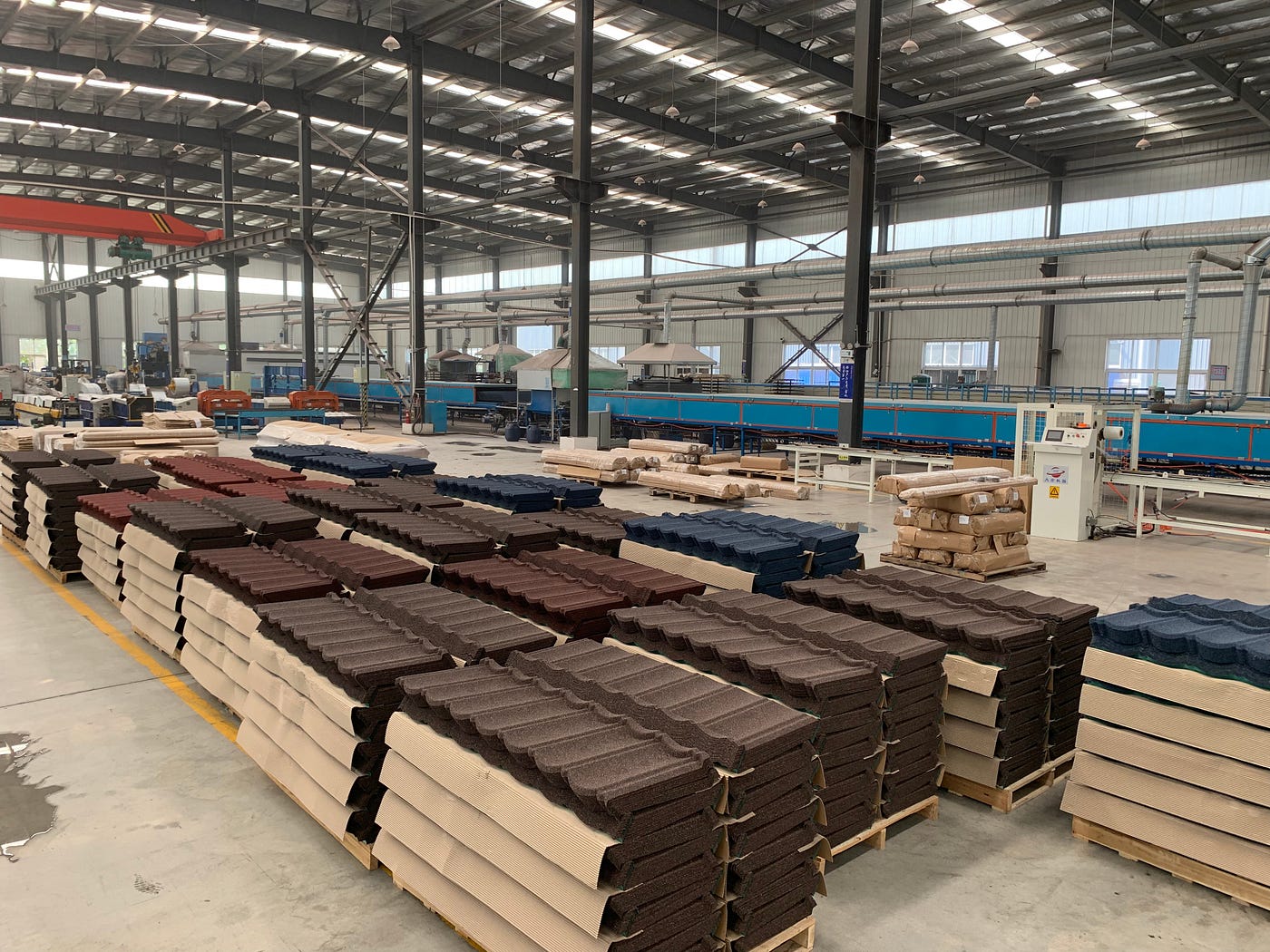
Finished tiles in production colours, staged on pallets inside the plant — the ground truth behind any factory claim.
Where the China route genuinely wins
The first advantage is cost, and it’s larger than most people assume — not because labour is cheap, but because a stone-coated tile is a low-weight, high-volume product with a long production run and very little hand work. Once a line is set up for a profile, the marginal cost of another tonne is small.
The second advantage is range. A domestic supplier usually carries the profiles that sell in its own region. A Chinese manufacturer serving export markets tends to carry a much wider catalogue, because its customers are everywhere. If you need a small amount of a profile your local distributor doesn’t stock, this matters more than the price.
The third advantage is OEM and private label. If you’re a distributor building your own brand, a stone coated roofing OEM private label supplier relationship is far easier to establish overseas. Domestic manufacturers protecting their own brand are frequently unwilling to sell you unbranded product at all.
Where domestic wins
Two things, and both are about distance rather than quality.
The first is approval. In the US, the document that gets a roof through permitting is an ICC-ES Evaluation Report, and it names a specific product and a specific installation method. A domestic manufacturer you’re quoting almost certainly has one for the exact product in front of you. An overseas supplier may have one for a different product, an expired one, or a test report that a code official has no obligation to accept. That gap has delayed more imports than any shipping problem.
The second is the small-replacement problem. A stone-coated roof is a system of interlocking pieces. When a job goes wrong — a botched flashing, a storm event, one damaged course — the question is how fast you can get a few squares of the identical profile and colour to a specific address. Domestic supply answers that in days. Overseas supply answers it in weeks, and only if the colour still matches the production run.
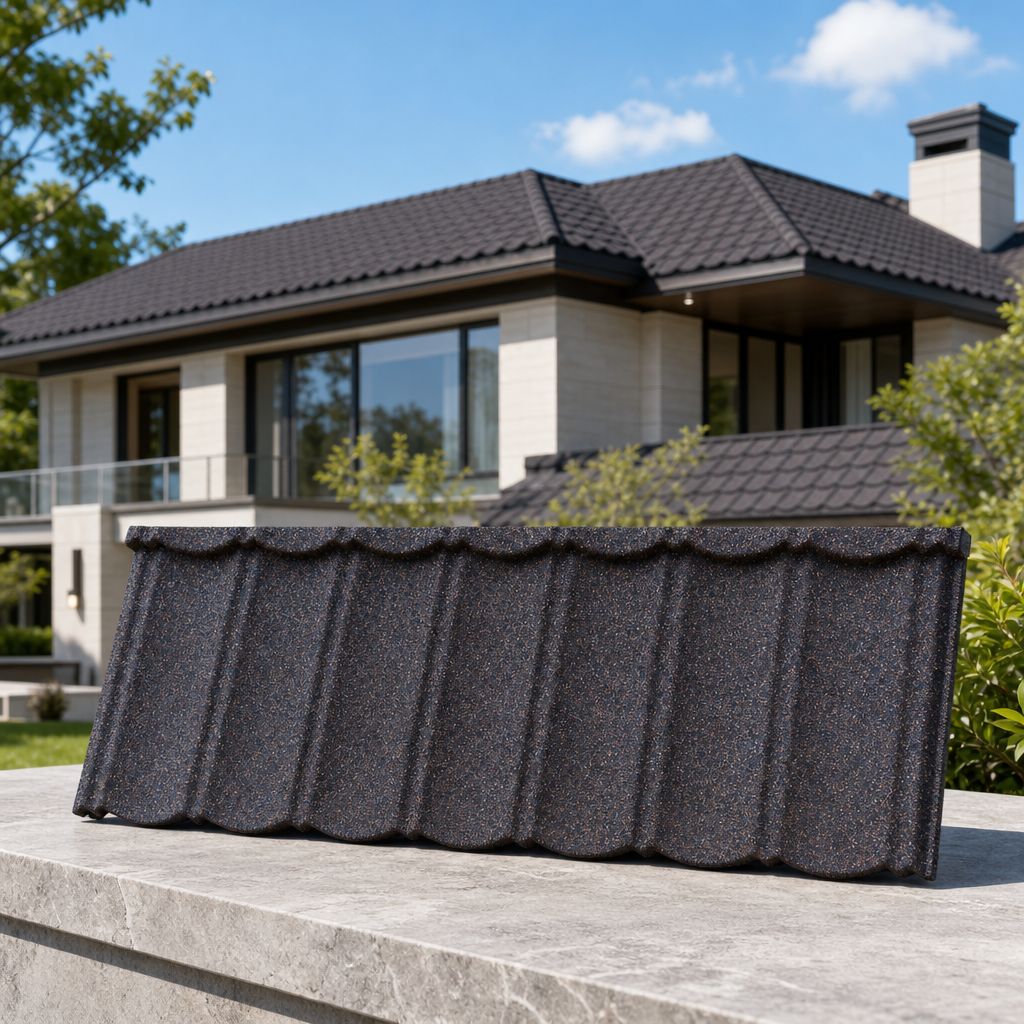
The granule bed is what you’re really auditing when you evaluate quality — and it’s the one thing no quote can show you.
The three costs that appear after the order
Code approval lag. Budget it as a line item, not a risk. If your market requires a stone coated roofing ICC-ES ESR code approval and the product you bought doesn’t carry one, you’re not buying roofing — you’re buying an argument.
Warranty enforcement distance. A 50-year stone coated roofing warranty service life claim means very little once you ask who performs the work and who ships the material when it’s invoked. Check the terms, not the number.
Quality control you cannot see. This is the one buyers actually lose sleep over, and it’s the wrong thing to lose sleep over. Good stone coated manufacturing quality control China is not a question about geography — it’s a question about evidence. Ask for the actual test reports, with report numbers, testing labs and dates: granule adhesion under ASTM D4977, coating adhesion under ASTM A1122, base steel to ASTM A792. “Meets ASTM” is not a document. A report number is.
The four questions that decide it
If you’re choosing between a stone coated steel roofing manufacturer in China and one at home, these are the questions that actually move the decision:
“Send me the ESR number.” Not the certification list. The specific report that names this product and this installation method. Verify it yourself against the ICC-ES directory rather than trusting a PDF.
“What’s the MOQ, and is it per profile or per colour?” A stone coated roofing MOQ sample quotation looks reasonable per profile and becomes unworkable per colour, because a three-profile, five-colour first order quietly turns into fifteen separate minimums. Settle this before you fall in love with a colour.
“Who owns the approval, and who holds the warranty?” Different answers here mean you’re dealing with a trading company, not a manufacturer, and the stone coated roofing distributor programme you’re being offered belongs to somebody else.
“What’s the real lead time on a repeat order?” First orders are always fast. Ask about the fourth. For anything time-critical, a stone coated roofing lead time urgent project needs a written commitment on production, not on shipping.
What Cailin actually offers here
This is where I have to be direct, because I work on this side of the trade.
Cailin manufactures stone-coated metal roofing in Bond, Shingle and Shake profiles across 12 production lines, supplying distributors, importers and contractors rather than homeowners. The OEM and private-label route is a normal part of what the factory does — including branded packaging, which is usually the first thing distributors ask about.
The catalogue is on the website: the full stone-coated metal roofing range.
If you’re weighing the two routes, the honest framing is this: the price advantage of importing is real and durable. The approval, warranty and replacement advantages of buying domestically are also real and durable. The mistake is assuming you have to pick a side of that trade-off wholesale. Most serious distributors end up running both — a domestic line for the jobs that can’t wait, and an import line for the volume that can.
The decision isn’t which is better. It’s which of your jobs is which.